Pages

Lucy Mills has moved!

You'll find all this content, plus more, over at http://lucy-mills.com.


Showing posts with label thinking. Show all posts

Friday, 29 July 2011

what’s the Internet doing to your brain?

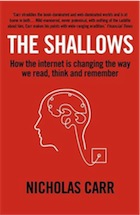
I’m currently reading The Shallows by Nicholas Carr.  Andy ordered it and I promptly nicked it, although to be fair he did inform me of its presence in the house, which is possibly asking for trouble.

Because it’s hugely relevant to my research – although my book focuses on memory (and the lack of it) it encompasses ways of thinking and learning.  Although Carr’s book is focused on how the Internet and related technologies change how we think, much of it is relevant and the rest of it is just plain interesting.

“I missed my old brain,” comments Carr near the beginning of the book, when he’d started to perceive how he was thinking differently – how he was skimming rather than deep reading, how it got harder to read longer pieces and still maintain concentration.  We are used the world of snippets, of hyperlinks, of immediacy.  Carr is not saying that modern technologies are bad things – he sees the advantages and the potential of them – but he feels a disquiet about what we might be losing.  His is a plea for balance – although it’s true that he seems to see the loss as being inevitable, as we are more and more shaped by the medium of the message, not merely the message itself.

I want to re-read it again after I’ve finished, this time with a pencil in hand – after Andy has read it obviously, I’m not that nasty – and will possibly post a few quotes here and there.  Enough to say for now that this is a deeply fascinating book and worth a look if you are interested in the Internet, how we think, or how they relate to each other, which is what this book examines.

Thursday, 19 May 2011

why I love Google Street View


Yesterday's trip went well.  I did indeed head library/cafewards initially - spilling out some words in my well weathered notebook, and having a quick peruse in the library itself before heading off for my 'appointment'. It was great talking to the two pregnancy centre workers - I find on-the-scene research really makes a subject come alive, and gives me the opportunity to meet new people too - we got on very well and I went away very glad to have made contact with such lovely people.

Of course all this entailed knowing where I was going. It was in fact on a bus route of one I already take frequently - it just went beyond the point where I usually got off. This is the classic problem I have always had with buses - knowing where to get off. You may know where it is on a map, but guessing it from the seat of a bus is quite another thing. This is why I love Google Street View. I get an advance glimpse of where I'm heading - not merely of road names on a map but the pizza places, shops, pedestrian crossings that all act as markers. I could tell, for example, that if I passed McDonald's I had gone too far - I'd need to get off at the next stop and backtrack.

And I need more than one marker. There is more than one set of traffic lights or traffic islands on a journey.  I need several backups - things that put the scene in context, let me know where I am in relation to my goal - and in relation to the other markers.


Uh oh.  Analogy approaching.

Sometimes we only use one marker in our patterns of thought and interpretation. We hurtle down the road thinking we're going in the right direction - aha!  Metaphorical weeping willow on right!  But we forget to look at the other markers which define the context, put things in a different light, show us another, better approach. Plus we forget that different people use different markers - different associations, memories, worldviews (street views?!). We can't understand why we've landed at such a different place.

I need to know what markers are there to tell me when to get off the bus. But I need to practise spotting them in life too - whether when reading the written word, listening to a conversation or a quiet confidence, understanding that there is usually more than one point of reference. If I forget to look for others, I usually misunderstand - I get off at the wrong stop and can't work out why.
"The desperate need today is not for a greater number of intelligent people, or gifted people, but for deep people."- Richard Foster